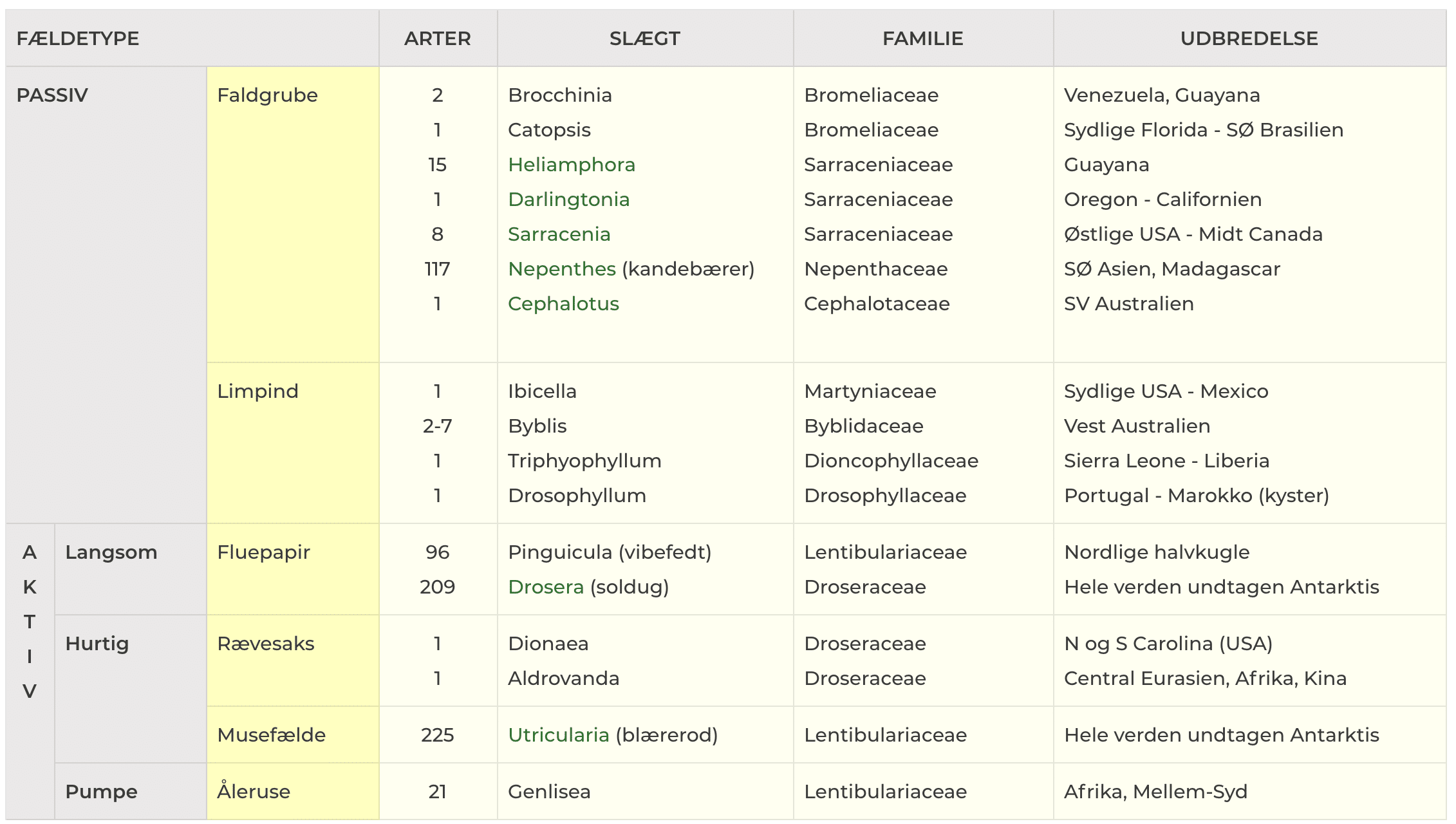
CARNIVOROUS PLANTS
| FÆLDETYPE |
ARTER
|
SLÆGT
|
FAMILIE
|
UDBREDELSE
|
||
| PASSIV | Faldgrube |
2 |
Brocchinia Catopsis Heliamphora Darlingtonia Sarracenia Nepenthes (kandebærer) Cephalotus |
Bromeliaceae |
Venezuela, Guayana Sydlige Florida - SØ Brasilien Guayana Oregon - Californien Østlige USA - Midt Canada SØ Asien, Madagascar SV Australien |
|
| Limpind |
1
2-7 1 1 |
Ibicella Byblis Triphyophyllum Drosophyllum |
Martyniaceae Byblidaceae Dioncophyllaceae Drosophyllaceae |
Sydlige USA - Mexico Vest Australien Sierra Leone - Liberia Portugal - Marokko (kyster) |
||
|
A
K T I V |
Langsom | Fluepapir |
96
209 |
Pinguicula (vibefedt) Drosera (soldug) |
Lentibulariaceae Droseraceae |
Nordlige halvkugle Hele verden undtagen Antarktis |
| Hurtig | Rævesaks |
1
1 |
Dionaea Aldrovanda |
Droseraceae Droseraceae |
N og S Carolina (USA) Central Eurasien, Afrika, Kina |
|
| Musefælde |
225
|
Utricularia (blærerod) |
Lentibulariaceae |
Hele verden undtagen Antarktis |
||
| Pumpe | Åleruse |
21
|
Genlisea | Lentibulariaceae | Afrika, Mellem-Syd | |
CARNIVOROUS PLANTS - AN OVERVIEW
In the table, all links connect to pages in English
TRAP TYPE
SPECIES
GENUS
FAMILY
DISTRIBUTION
PASSIVE
Pitfall
2
1
15
1
8
117
1
Brocchinia
Catopsis
Heliamphora
Darlingtonia
Sarracenia
Nepenthes
Cephalotus
Bromeliaceae
Bromeliaceae
Sarraceniaceae
Sarraceniaceae
Sarraceniaceae
Nepenthaceae
Cephalotaceae
Venezuela, Guayana
Southern Florida – SE-Brasil
Guayana
Oregon – California
Eastern USA – Cenral Canada
SE-Asia, Madagascar
SW-Australien
Lime twig
1
2-7
1
1
Ibicella
Byblis
Triphyophyllum
Drosophyllum
Martyniaceae
Byblidaceae
Dioncophyllaceae
Drosophyllaceae
Southern USA – Mexico
West Australia
Sierra Leone – Liberia
Portugal – Morocco (coastal)
ACTIVE
Slow
Flypaper
96
209
Lentibulariaceae
Droseraceae
Northern hemisphere
Global except Antarctica
Fast
Fox trap
1
1
Droseraceae
Droseraceae
N and S Carolina (USA)
Central Eurasia, Africa, Australia, China, Japan
Pump
Eel trap
21
Genlisea
Lentibulariaceae
Africa, Central America-South America
Comments to the table:
Carnivorous plants are defined as plants able to a) lure, b) catch, c) break down smaller animals by an exogenous (outside, i.e. on the surface of the trap) digestive process and d) absorb the digestive products by special glands on the surface of the trap. Several plants have the ability to carry out one or more of the items, but all four items must be fulfilled before a plant can be classified as carnivorous.
The classification used in the table above considers if the trap or part of the trap perform a movement during the capture (Passive, Active) and the method used for capturing prey. In some genera the number of species has increased considerably in recent years, primarily as a consequence of splitting up ‘old’ species. In this way the total number of carnivorous flowering plants is now about 600.
Drosophyllum was earlier included in Droseraceae. The genus Biovularia is now included in Utricularia, and some taxonomists argue that Polypompholyx should also be included in Utricularia. Lentibulariaceae is often used as synonym for Utriculariaceae, the bladderwort family. The genera Brocchinia, Catopsis, and Ibicella also include non-carnivorous species. In species rich genera, the shown figure is most likely a minimum figure since it is still possible to find new species in poorly investigated areas.
The Danish page Carnivori på frimærker shows stamps with carnivorous plants as motive.
H. S. Heide-Jørgensen – updated January 2024