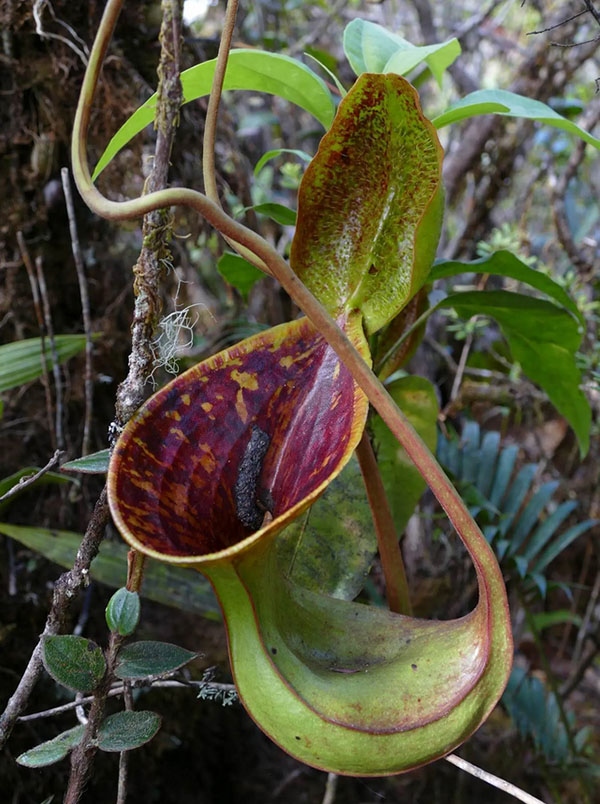
Lower pitchers of N. ampullaria er ca. 10 x 7 cm with reflexed lid
Nepenthes ampullaria is one of the most widespread species, and it is very variable in terms of both the jug’s shape, size and color pattern. Many varieties have been described, and it hybridizes naturally with at least 10 other species. The plant forms a compact rosette, with the lower pitchers resting on the ground. The stem climbs up to 20 m to get enough light to flower, but only sets very few and small jugs. Lateral shoots from the basal rosette form new rosettes with pitchers, so that the pitchers thereby become carpet-forming. The species is particularly interesting in that a significant part of its nitrogen needs is covered by the breakdown of plant material that falls into the completely open jugs, and it is so far the only species that secretes the starch-degrading enzyme amylase.
Nepenthes lowii
Nepenthes lowii, Borneo. Photo: François Mey
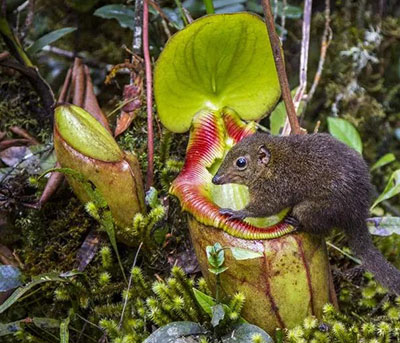
Nepenthes lowii is endemic to Borneo, found at elevations between 1,650 and 2,600 meters in the regions of Sabah, Sarawak, and Kalimantan. Initially, it has a creeping habit with slender pitchers up to 12 cm tall and 5 cm wide, and a lid functioning like an umbrella. Later, N. lowii adopts a climbing habit with stems reaching up to 13 m in length; the pitchers become hourglass-shaped up to 26 cm tall with a 16 cm wide opening and the lid curves backward, similar to that of N. ampullaria, leaving the pitcher’s mouth fully exposed. These pitchers are visited by the mountain treeshrew (Tupaia montana), which perches on the pitcher rim to lick nectar from the underside of the lid. While doing so, it deposits nitrogen- and phosphorus-rich droppings into the pitcher, thereby helping N. lowii meet part of its nutritional needs. In the picture on the left, it appears as a reward is about to fall into the pitcher. The reflexed lid and the wide opening with abundant nectar production are essential for this mutually beneficial relationship (mutualism) with the treeshrew to function. Two other Bornean species, N. rajah and N. macrophylla, are also visited by the treeshrew, though less frequently. It is likely that birds perching on the pitcher rim also contribute droppings.
The picture on the right shows the treeshrew on N. kinabaluensis, a hybrid between N. rajah and N. villosa from Mount Kinabalu; here, abundant nectar production is not observed. Photo: Mediastorehouse.co
Literature: Chin L., A. Moran & C. Clarke 2010: Trap geometry in three giant montane pitcher plant species from Borneo is a function of tree shrew body size. – New Phytologist 186 p. 461-470. McPherson, S. 2009: Pitcher plants of the old world. Vol. 1. Red Fern Natural History Productions. 631 pp.
H. S. Heide-Jørgensen, Dec. 2009. Translated Jan. 2024.