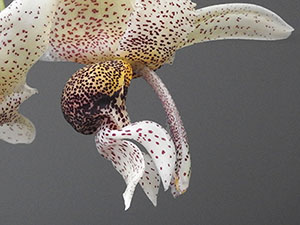
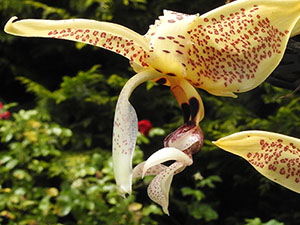
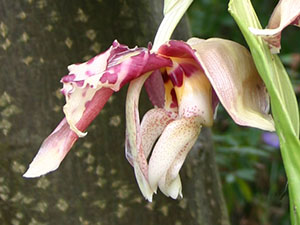
There are at least 25,000 natural orchid species, and virtually all of them are insect-pollinated. Some can be pollinated by several different insects, but many are so specialized that they can only be pollinated by a single specific insect species. Co-evolution has thus occurred between orchid and insect. This ensures effective cross-pollination but increases the risk of both species going extinct if living conditions for even just one of them change unfavorably. This page illustrates the very sophisticated examples of the interaction between flower and pollinator in the genera Stanhopea and Embreea, but first, the structure of the orchid flower must be explained.
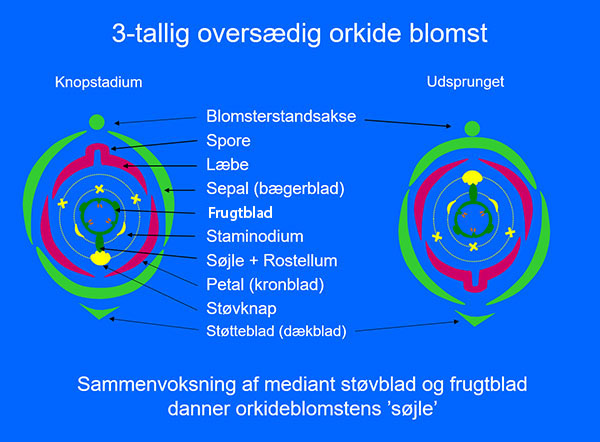
A flower consists of several whorls of leaves: carpels innermost and sepals outermost. The number of leaves in each whorl varies. In orchids there is only a single whorl of stamens with only one developed anther. The others are either completely absent or reduced non-functional stamens known as staminodes. Orchids have epigynous flowers, meaning the perianth segments (sepals and petals) and stamens are fused to the carpels almost up to their tips where the stigma is placed. The orchid flower is zygomorphic, meaning it has only one plane of symmetry, much like a pea flower. As the bud develops, the ovary and flower stalk twist so that, in the open flower, the lip (labellum) faces downwards acting as a landing place for the visiting insect.
Stanhopea and Embreea are tropical South and Central American orchids that grow as epiphytes on rainforest trees. Stanhopea comprises 55–78 species according to Plants of the World Online (Kew), whereas Embreea is a monotypic genus formerly included in Stanhopea. During each growing season, a more or less spherical pseudobulb, bearing a single oval leaf, develops on each shoot. The pseudobulb produces an inflorescence that grows downwards under the influence of gravity. The inflorescence bears (1)2–8 strongly fragrant flowers, each up to 20 cm in size, with a short lifespan of approximately four days.
Stanhopea
Stanhopea oculata is found in Mexico, Guatemala, Honduras, and Belize. The genus is named after Philip Henry Stanhope, 4th Earl of Stanhope (1781–1855), who was president of the Medico-Botanical Society of London. The genus was named by the botanist William Jackson Hooker. The specific epithet translates to “hood-shaped,” referring to the shape of the flower. The inflorescence bears 2–8 strongly fragrant flowers, each up to 20 cm in size, with a short lifespan of three-four days.
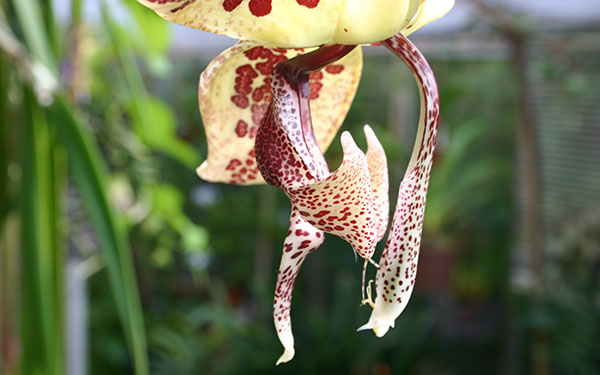
Stanhopea oculata with three open flowers. Behind the flower on the right, another developing inflorescence is visible. It produced five flowers, as shown on the left. The flowers emit a strong scent to attract insects for pollination. This potent fragrance must be viewed in the context of the flowers’ short lifespan and the often considerable distance between plants.
Stanhopea is pollinated by euglossine bees, also known as orchid bees, though they also visit other flowers, as shown in the photo. These bees are similar in size to large bumblebees and often feature brilliant, metallic-sheen colors and a tongue that can be longer than their body. The fragrances particularly attract male bees, which collect scents from the back of the labellum using brushes on their forelegs and store them in pockets on their hind legs. These fragrances are believed to attract female bees. Photo: Pedro Turner.
The bee lands on the central part of the highly specialized labellum (lip). The stigma is located near the base of the lip, where the long, curved column (gynoecium) emerges. If the bee is carrying pollinia from another flower, the pollinia will usually be attached to the back of its thorax; as the bee scrapes scent compounds from the base of the lip, the pollinia will typically be rubbed off onto the stigma.
The scent compounds have a temporary stupefying and anesthetic effect on the visiting bee. The bee loses its footing and slides down the lip, which acts as a chute. Projections on the sides of the lip (the chute) force the bee into contact with the tip of the column, where the pollinia are located. The pollinia are thereby torn from the anther and attached to the bee’s back (specifically the thorax) by means of an adhesive disc (viscidium); the bee then recovers and flies on to the next flower. In the picture, the viscidium is attached to the tweezers.
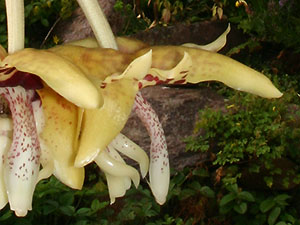
Stanhopea martiana is endemic to southeastern Mexico. The epithet ‘martiana‘ is a Latinization of the name of the German botanist Carl Friedrich Philipp von Martius (1794–1868). The figs. above show that the lip and column are dimensioned differently than in S. oculata. This indicates that the two species are pollinated by Euglossine bee species of different sizes. In cultivation, S. martiana requires a minimum temperature of 12°C during the winter.
Stanhopea napoensis grows in the humid lowlands of Ecuador on the eastern slopes of the Andes at elevations of up to 600 meters. The specific epithet refers to the province of Napo, with the suffix –ensis meaning “belonging to.” S. napoensis was named by the botanist Calaway H. Dodson. The lip is adapted to yet another species of euglossine bees.
Stanhopea tigrina is endemic to Mexico and grows in rainforests at elevations between 600 and 1,700 meters above sea level. The species was named by botanists Bateman and Lindley; the epithet tigrina means “tiger-like,” though in this instance it primarily refers to the large size of the flowers (15–17 cm). There are numerous synonyms and varieties. In cultivation, the species tolerates nighttime temperatures as low as 10°C. The passage between the lip and the tip of the column is narrower here than in the previously mentioned species, suggesting that pollination is carried out by a smaller species of Euglossine bees. Extracts from the leaves and pseudobulbs are used locally to treat mental disorders and impaired kidney function, and their beneficial effects have been confirmed by ethnobotanical studies.
The scents produced vary from species to species, and the following have been identified: methyl cinnamate, methyl salicylate, 1,8-cineole, benzaldehyde, and linalool. The strong morphological and chemical specialization of the Stanhopea flower means that only one sex of a few, or even just a single insect species is capable of carrying out pollination. Such an adaptation took millions of years to develop, arising through a parallel specialization of plant and insect known as co-evolution. The system ensures precise pollination with the correct pollen, but if environmental changes cause one part to go extinct, the other follows suit.
Embreea
Embreea rodigasiana is the only species in the genus. It is found in Colombia and Ecuador. The species was formerly classified under Stanhopea, but in 1980, the botanist Calaway H. Dodson established the genus Embreea and reassigned S. rodigasiana to it, noting that Embreea has square pseudobulbs with sharp edges whereas Stanhopea pseudobulbs are more rounded and that Embreea produces only one flower per pseudobulb and has a differently shaped lip. The epithet rodigasiana honors the Belgian horticulturist Émile Rodigas. Like Stanhopea species, E. rodigasiana grows in rainforests and is found at elevations between 400 and 1,500 meters above sea level.
Pollination in Embreea is carried out by euglossine bees, following the same principle as in Stanhopea. On the left photo, the tip of the column is visible, and the yellow pollinia can be discerned within the semi-transparent anther cap. The adhesive disc (viscidium) is visible between the two slender appendages. The center image shows the pollinia released from the anther cap. The fig. on the right shows an open capsule that once held thousands of seeds. The weight of a single seed is in the order of 0.000003 g. The fact that all pollen grains are transferred together in pollinia provides a degree of assurance that all ovules will be pollinated. It is not known how the flower shown here was pollinated in my greenhouse; self-pollination can occur in some orchids.
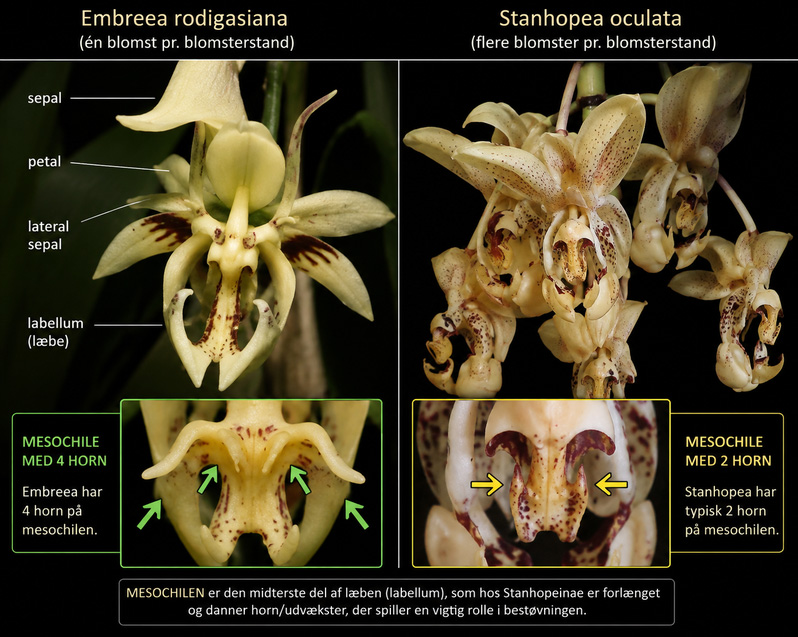
I asked ChatGPT to describe the differences between Embreea and Stanhopea. This resulted in the figure above showing the mesochile of the lip, that is the middle section of the lip’s three parts. The mesochile has four projections (referred to as horns) in Embreea, whereas Stanhopea has only two, which point forward. However, I do not find the placement of the arrows particularly convincing; therefore, the horns of Embreea are shown on the left, and below them, the two highly variable horns found in my Stanhopea species.
Stanhopea martiana
Stanhopea napoensis
Stanhopea oculata
Stanhopea tigrina
Literature: Bechtel H, Cribb P, and Launert E 1981: The manual of cultivated orchid species. Blandford Press, Dorset https://www.britannica.com/animal/euglossine-bee https://pubmed.ncbi.nlm.nih.gov/38794158/ https://www.theorchidcolumn.com/2014/10/stanhopea-connata.html